
Reputation management for individuals
Reputation management for a private individual is almost always about a single item rather than an ongoing programme: a court record, an article, a photograph, a review of a business they no longer own, or a listing on a people-search site. Each of those has a different route, and some have no route at all. The first task is therefore identification rather than action, because paying a monthly retainer for a problem that has one defined request is the most common way individuals in this position get overcharged. A surprising share of cases also turn out to be someone else with the same name.
Records and articles: what an individual's problem usually consists of
Businesses have reputation programmes. Private individuals almost always have an item. Sorting which item you have is most of the work, because the routes barely overlap.
| The item | Who published it | Realistic route |
|---|---|---|
| An arrest or court record | A court, a sheriff, an aggregator | Sealing or expungement where eligible, then aggregator removal requests |
| A news article | A publication | Correction if a fact is wrong; otherwise suppression |
| A review of a business you owned | A customer, on a platform | Policy report if it breaks the rules; often nothing |
| A social post or photograph | You, or someone else | Delete or ask; report if it breaks platform policy |
| A people-search listing | A data broker, from public records | Opt out, one broker at a time, repeatedly |
| Someone else with your name | Nobody, it is a collision | Disambiguation, not removal |
The bottom row deserves its own heading, because it is the case people least expect and the one where the standard advice does the most damage.
Mistaken identity, and why it fails a background check
A large share of what individuals believe is a reputation problem is a name collision. Somebody who shares your name has a criminal record, a bankruptcy, a bad review, an unpleasant forum history, and the search engine has no way to know you are two people.
Removal is the wrong tool here, because the content is accurate about someone. It just is not about you. What works is disambiguation: publishing enough correct, indexable material tied to your name plus a distinguishing detail, so that a search for your name resolves to you and a person looking has an obvious way to tell the difference. A middle initial, a profession, a city, a professional profile, a personal site. If the confusion is causing a concrete harm, such as a failed background check, the fix belongs in the dispute process for that report rather than in search results at all.
Where to start: build the inventory before you buy anything
Nobody should pay for reputation work before they know what is actually published. The inventory takes an evening.
- Search signed out, in a private window, on your full name in quotation marks. Then your name plus your city, employer, and profession.
- Search your name variants. Maiden name, middle initial, nickname, misspellings people actually use.
- Check the image tab, which frequently surfaces material the main results do not.
- Search your phone number and email address, which is how people-search sites index you.
- Record each result with its URL, who published it, and whether it is true. That third column is the one that decides everything.
The output is a short list, usually of three to eight items, and it is normally shorter and less alarming than the anxiety that prompted it. The page on how to google yourself covers the method in more detail.
The free routes an individual actually has
Two of the most useful tools for an individual cost nothing, and neither is well known.
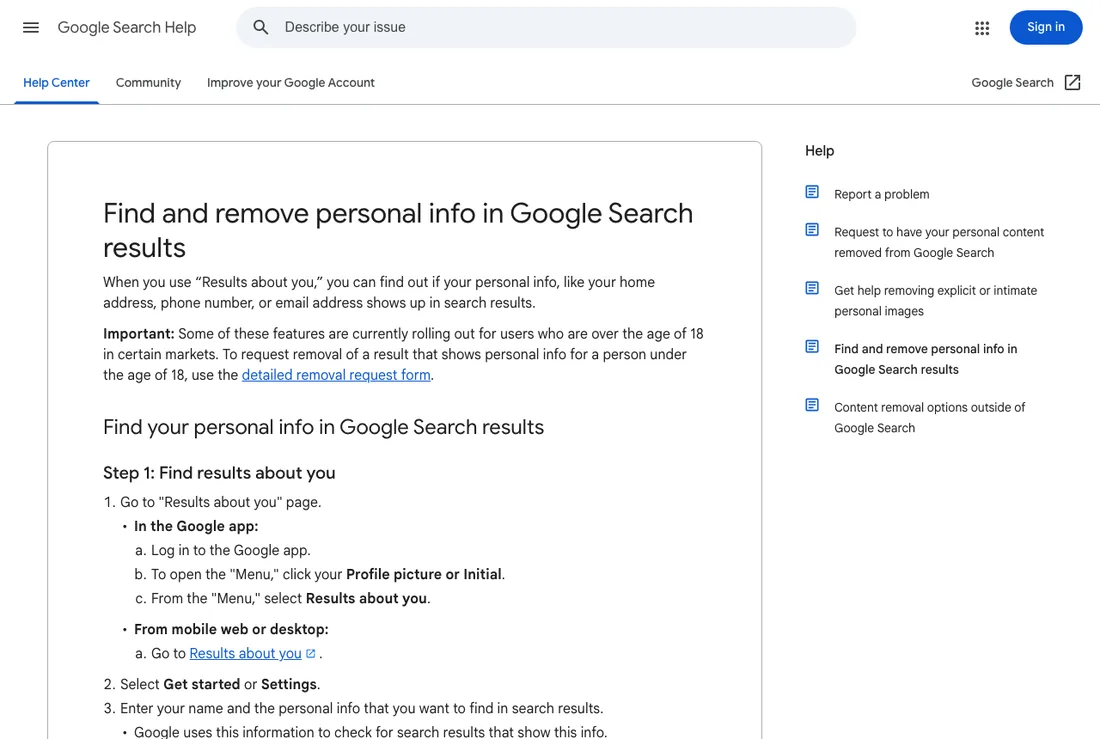
Google's own tool for finding and requesting removal of results containing your personal contact information. It is free, it is available to anyone, and it covers a narrower category than most people assume: contact details and certain identifying records, not unflattering content. Screenshot taken 19 August 2026.
The first is Google's removals process for personal information. Google's policy on removing personal information from Search sets out the categories it will act on, which centre on contact details, government identification numbers, financial account information, and certain images. It does not cover a news article about you, a court record, or a review. Knowing the boundary saves weeks of requests that were never going to succeed.
The second is data broker opt-outs. People-search sites assemble a profile from public records and sell access to it, and most publish an opt-out procedure because they are required to or because it is cheaper than arguing. The Privacy Rights Clearinghouse data broker directory is a working list to work through. Expect it to be tedious, expect some to reappear after a data refresh, and expect the paid services in this space to be doing the same manual process you could do yourself.
Beyond those, FTC consumer advice on protecting your privacy online covers the preventative half: account settings, what you hand over to apps, and how much of a profile is assembled from things you volunteered.
What it costs an individual
The most common way a private individual gets overcharged is by being sold a monthly programme for a problem that is one item with a single route.
Reputation work for an individual splits into two shapes. A defined item with a defined route should be priced as a project: this record, this request, this outcome or this refusal, for a stated fee. Ongoing suppression of a result that will not come down is genuinely a monthly engagement, because it requires publishing and maintaining material over months, and anybody who tells you otherwise is compressing a timeline they do not control.
The questions that separate the two: what exactly is being removed or suppressed, by what mechanism, what happens if the platform refuses, and what am I paying for in month six. A provider who cannot answer the second question in one sentence is selling effort rather than a route. The page on what reputation management costs sets out the ranges and the reasons behind them.
What is not going to come down
The honest part, and the reason people distrust the category is that it is usually omitted.
- A truthful review of a business you ran is an opinion, and opinions are not removable.
- Accurate news reporting does not come down because it is embarrassing. Corrections exist for errors of fact.
- A public court record stays public unless a court seals or expunges it, and an expungement does not reach the news article that reported the case.
- A post someone else made on their own account is theirs. Platforms remove it for policy violations, not for being unwelcome.
- Search engines do not delete anything. They index what exists. Removing a result from Google does not remove the page.
Where the item falls into one of those, suppression is the remaining option and it is slow, honest work rather than a deletion. Which of these categories yours belongs in decides the cost, the timeline, and whether to spend anything at all, and it is the first thing a reputation audit establishes.
Questions about reputation management for individuals
Do individuals need reputation management?
Only when a search for their name is part of how people decide about them and what it returns is wrong, outdated, or absent. Many people who look find nothing that needs paid help, which is a legitimate outcome.
What does it cost for an individual?
It depends on which shape your problem is. A single item with a defined route should be priced as a project with a stated fee. Ongoing suppression of something that will not come down is genuinely a monthly engagement over months.
Can I remove my name from Google myself?
You can request removal of results containing personal contact information through Google's own free process, and you can opt out of data broker listings. Neither reaches news articles, court records, or reviews.
What if the bad result is about someone with my name?
That is a disambiguation problem rather than a removal problem. Publishing accurate material tied to your name and a distinguishing detail works better than requesting removal of content that is true about another person.