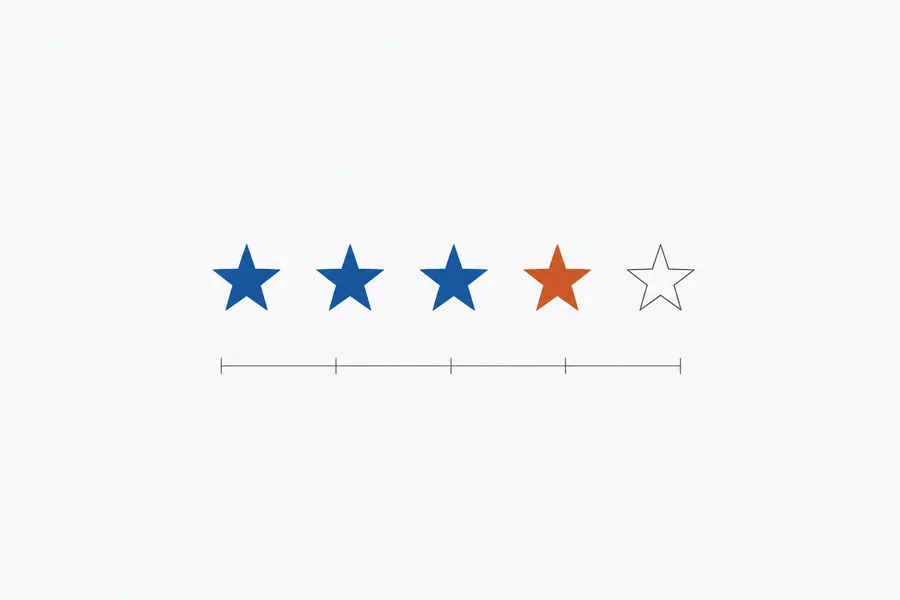
Is there an online reputation score?
There is no standard online reputation score. Nothing is computed the same way twice, nothing is portable between products, and no authority publishes one. What exists instead is a market of proprietary scores: review platforms average star ratings, monitoring tools blend mentions with software assigned sentiment, and survey firms model perception among panels they recruit themselves. Each output is internally consistent and externally meaningless. A 78 from one product and a 4.3 from another are not two readings of the same thing. This page explains what those numbers are built from, what they leave out, and how to read one you have been handed.
What a reputation score actually is
A reputation score is a number a product computes about you from inputs it selected. That is the entire definition. There is no registry of reputation scores, no agreed scale, and no body that certifies one. Two products can look at the same business in the same week and return figures that disagree, and neither is wrong, because they were never measuring the same quantity.
The expectation that a standard score exists comes from credit. A credit score is standardised across lenders, and it sits inside a legal framework that gives a consumer the right to see the underlying file and dispute what is in it. Reputation scoring has none of that scaffolding. No vendor is obliged to show you its inputs, and there is no process for correcting a score you believe is wrong. Your only leverage is the underlying material the score is reading.
How a reputation score is calculated
Most commercial scores are built from some combination of six ingredients. The mix is the product.
| Input | What it usually measures | What it cannot see |
|---|---|---|
| Star rating average | The mean of public ratings on one or more platforms | Who chose to review, and why |
| Review volume and recency | How many ratings arrived, and how recently | Whether the reviews describe the same thing |
| Sentiment classification | Software assigned polarity of review and mention text | Sarcasm, negation, and mixed opinion in one sentence |
| Mention volume | How often the name appears across monitored sources | Whether the mention refers to you at all |
| Search results composition | What ranks on the first page for the name | What a reader does after seeing it |
| Survey panel perception | Rated perception among a recruited sample | Anyone the vendor did not recruit |
Each ingredient is then weighted, and the weights are the vendor's opinion about what matters. A product built for local service businesses leans on star ratings and review recency. A product built for large corporations leans on survey perception and press coverage. Neither weighting is neutral, and neither is published in enough detail for anyone outside the company to reproduce.
Why vendor scores are not comparable
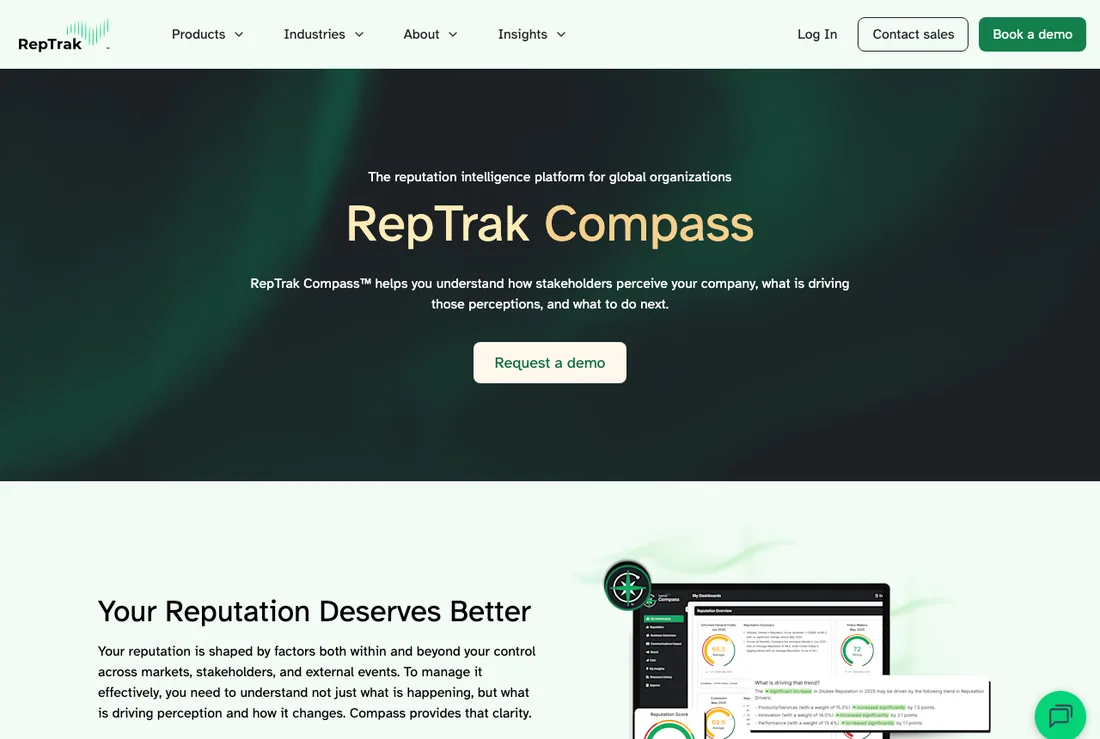
A commercial reputation measurement platform. The figure a product like this reports is defined by its own model, its own source set and its own respondents, which is exactly why it cannot be set beside a different vendor's number. Screenshot taken 19 August 2026.
Scales differ: some report 0 to 100, some 0 to 10, some restate a star average. Windows differ, and a rolling ninety days describes a different business from a lifetime average. Source sets differ, so one tool reads four review platforms while another reads forty sources including news and social. Some scores are normalised against an industry benchmark the vendor assembled itself, which means your number moves when other companies move, without anything changing about you.
The practical consequence is worth stating plainly. Switching monitoring tools will change your score, and the change carries no information. Comparing your score against a competitor's score from a different product carries none either. The only comparison that means anything is your own number against your own number, computed the same way, over time.
The star rating average, and what it hides
The number most people mean by a reputation score is the star average on their most visible listing. It is the most useful single figure available, and it still conceals three things: the count behind it, the distribution behind it, and the age of the ratings. A 4.6 from eleven reviews and a 4.6 from nine hundred are different claims about a business. A 4.6 assembled from fours reads differently from a 4.6 assembled from fives and ones, and the second usually means something specific is going wrong for a minority of customers.
The average matters beyond the reader, because platforms use it themselves. Google's guidance on local ranking factors describes prominence as one of the three things that decide local ranking, and names review count and review score among what feeds it. That is the closest thing to an official reputation score in existence, it is never published as a number, and you cannot see it.
What a score cannot capture
- The people who never wrote anything. Reviews arrive from the tails of an experience. The quiet middle is invisible to every score ever built.
- The single result that outweighs the average. A 4.8 rating does not help much when the second organic result for the business name is a complaint thread.
- Severity. Ten complaints about slow email replies and one about a safety failure can move a score by the same amount. They are not the same problem and they do not get the same response.
- Context inside the text. Automated polarity scoring rests on natural language methods whose failure modes are documented at length in the published research, including decades of it indexed in the ACL Anthology of natural language processing research. Sarcasm, negation and domain specific vocabulary defeat it in predictable ways.
- Anything not written down in public. Referrals, word of mouth, a complaint made to a manager, a bid you lost without ever hearing why.
A score has no standing anywhere
The word score implies an authority behind it, and there is none. No regulator supervises reputation scores. No platform accepts one as a reason to remove content. No court consults one, because a claim about a false statement runs through defamation law and its defined standards, such as the actual malice standard set in New York Times Co. v. Sullivan for public figures, rather than through a vendor dashboard. A reputation score is a private opinion about you expressed as a number, and it is worth precisely what its method is worth.
How to read a score you have been handed
- Ask what goes in. If the vendor will not list the sources and the rough weighting, the number is a marketing device rather than a measurement.
- Ask the window. Rolling ninety days, twelve months and all time answer different questions, and a vendor switching windows can produce a rise you did not earn.
- Ask the scale, and whether it is normalised. A score benchmarked against an industry set moves with that set. You need to know which movements are yours.
- Look past the mean. Pull the distribution and the recency curve. They tell you what to fix; the average only tells you where you stand.
- Compare it only to itself. Same tool, same settings, same window, tracked across months.
- Decide what it is for. A score is useful as a trend line and a trigger for a closer look. It is not useful as a target, because targets get gamed.
A score is a summary, and a summary only helps once you know what is being summarised. If the question is what actually appears about you rather than what a dashboard says about it, that is what a reputation audit reads first: the results, the reviews and the sources, before any number is put on them.
Questions about is there an online reputation score?
Is there an online reputation score?
Not a standard one. Several products sell a score, but each defines its own scale, sources and weighting, so the numbers are not comparable with each other and none of them is official.
How is a reputation score calculated?
Usually from star rating averages, review volume and recency, software assigned sentiment, mention counts, search result composition, or survey panel perception, blended with weights the vendor sets and rarely publishes in full.
Does a bad reputation score affect my Google ranking?
A vendor score has no effect at all, because Google does not read it. Google's own local ranking guidance does name review count and review score as inputs to prominence, so the star average on your listing matters in a way a dashboard number does not.
Can I dispute a reputation score?
There is no dispute process, no regulator and no right to see the underlying file. The only route is to change what the score is reading: the reviews, the search results and the sources behind it.