How do I fix wrong information about me in AI answers?
You do not edit the model, you change what it reads. A wrong statement in an AI answer almost always traces back to something: a page, a listing, an old article, a review, or a claim repeated often enough to look settled. The work is to find that source, correct or remove it where it lives, publish accurate material the retrieval layer can find, and then recheck over weeks. Some of it moves quickly. Some of it does not move at all, and this page is specific about which is which.
Source correction starts with finding the source
Before you can fix anything you need to know what you are fixing. Ask the assistant the question that produced the wrong answer, then ask it directly where that came from. Where it cites, open every citation. Where it does not cite, search the wrong claim as a phrase and see what comes back.
Most wrong answers fall into a small number of causes, and the cause decides the route.
| Why the answer is wrong | Where it came from | What actually fixes it |
|---|---|---|
| An old fact, once true | A stale page or listing still live | Update or remove that page, then wait for a recrawl |
| A factual error someone published | A specific article or profile | A correction request to whoever published it |
| A policy-breaking review or post | A platform with published rules | A complaint under those rules |
| Two entities confused | Similar names, thin sources | Publish clear, consistent identifying detail |
| Invented outright, no source | Generation, not retrieval | Feedback to the vendor, plus better published material |
Authoritative publishing: give the retrieval layer something better to read
Where the wrong claim came from a page you do not control and cannot get changed, the remaining lever is the material you do publish.
That means an accurate page, on a domain that plausibly speaks for you, that answers the question directly in its own paragraph rather than burying the fact in a brochure. It means consistent naming: the same legal name, the same address, the same service description everywhere it appears, because inconsistency is one of the ways two entities get merged in the first place. And it means sourcing your own claims, because a passage with a checkable reference behind it is easier for any system to reuse than an assertion.
Google's own explanation of AI in Search describes generated answers as sitting on top of the same web index rather than replacing it. That is the practical opening: the material a retrieval step reads is ordinary published content, subject to ordinary publishing work.
Platform feedback channels, and what they actually do
Every major assistant has a way to flag a bad answer, usually a thumbs-down and a comment box, plus a separate privacy or legal contact for personal data. Use both. They are worth using and they are not a ticketing system: you will not usually get a case number, a decision, or a confirmation that a specific sentence has been changed.
Where the underlying source is a platform with published rules, the platform's own process is far more concrete. Google's process for reporting an inappropriate review, for example, produces an actual decision about an actual piece of content, and removing that content removes it from what any retrieval step can read later.
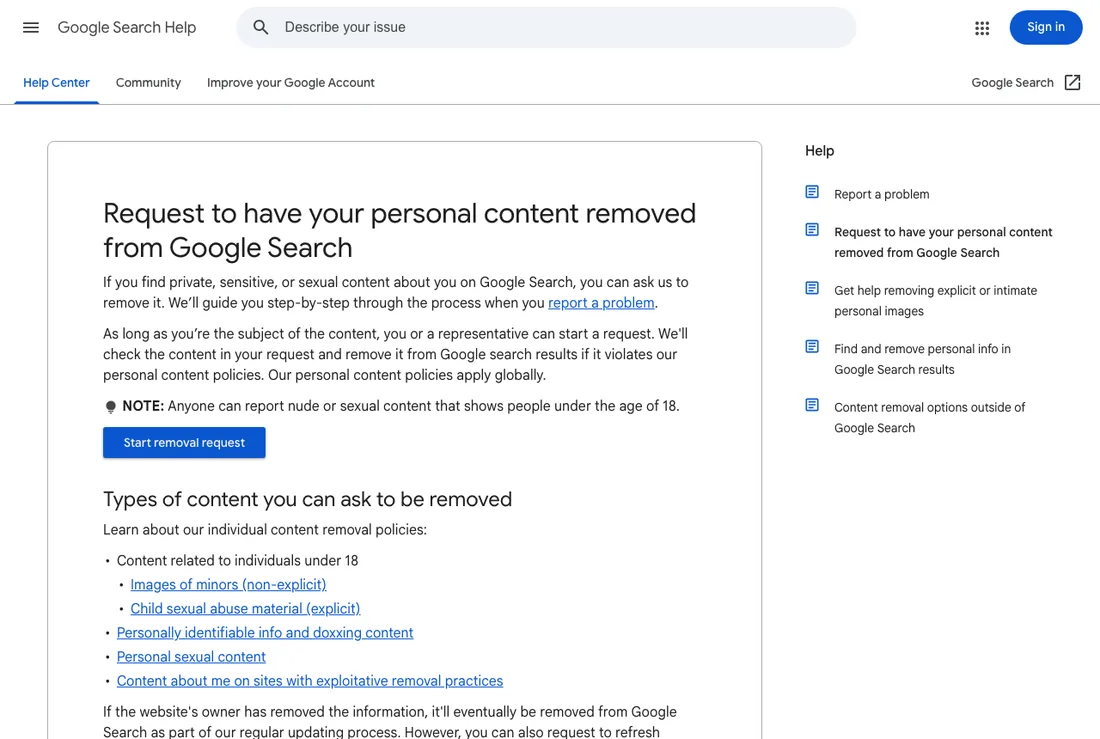
Google's request route for personal content in Search. It decides whether a URL appears in Google results, which is upstream of anything a retrieval step reads there. It is a policy process, not a legal one, and it is free. Screenshot taken 19 August 2026.
Retraining lag, and why a fixed page is not an instant fix
Between fixing a source and seeing a better answer there are several unsynchronised steps: the page has to be recrawled, the index has to update, the retrieval step has to actually pick that page, and any cached answer has to expire. Where the claim came from training rather than retrieval, none of those steps apply and the wait is the life of that model version.
So the recheck schedule matters more than the recheck. Check weekly for a month or two, in fresh sessions, with the same prompts, and write down what you see. A single recheck an hour after filing tells you nothing at all.
Realistic expectations
Three things are true at once, and leaving any of them out produces a misleading page.
- Corrections at the source usually work. This is the bulk of real cases, and it is unglamorous ordinary work.
- Nobody controls the output. There is no dial, no removal request that reaches a model's beliefs, and no method that promises a particular sentence will stop appearing.
- Truthful negative material stays truthful. A fair bad review, an accurate news report, a public record: none of these become removable because an assistant repeated them. What can be corrected is inaccuracy, not unflattering accuracy.
A working sequence
- Reproduce it. Same prompt, fresh session, three or four times, so you know it is consistent rather than a one-off.
- Record it verbatim, with the date, the assistant, and any sources it cited.
- Trace each error to a page, a listing, a platform item, or to nothing.
- Act at the source: correction request, policy complaint, listing edit, or legal route where one genuinely applies.
- Publish the accurate version somewhere clear, consistent, and easy to read.
- Recheck weekly, and keep the log so you can see movement rather than guess at it.
Working out which of your errors have a fixable source behind them is the part that decides everything else, and it is the first thing a reputation audit sets out.
Questions about how to fix wrong information in ai answers
How do I fix wrong information about me online?
Find where the claim is published, correct or remove it there, and publish an accurate version somewhere clear. AI answers follow their sources, so the source is the thing to work on.
How long until AI updates?
Where the answer came from live retrieval, usually weeks, and unevenly. Where it came from training data, there is no reliable timeline and any specific date is invented.
Can I report a wrong AI answer directly?
Yes, every major assistant has a feedback control and a separate privacy contact, and both are worth using. Neither works like a ticket system, so treat them as one input rather than the fix.
What if the wrong claim has no traceable source?
Then it was generated rather than retrieved. Use the vendor feedback channel, and put the correct information somewhere clear and consistent so retrieval has something better to read.
Does removing a page fix the AI answer?
It removes one input. If copies exist elsewhere, or the claim was learned during training, the answer can persist until those copies go or the model is replaced.