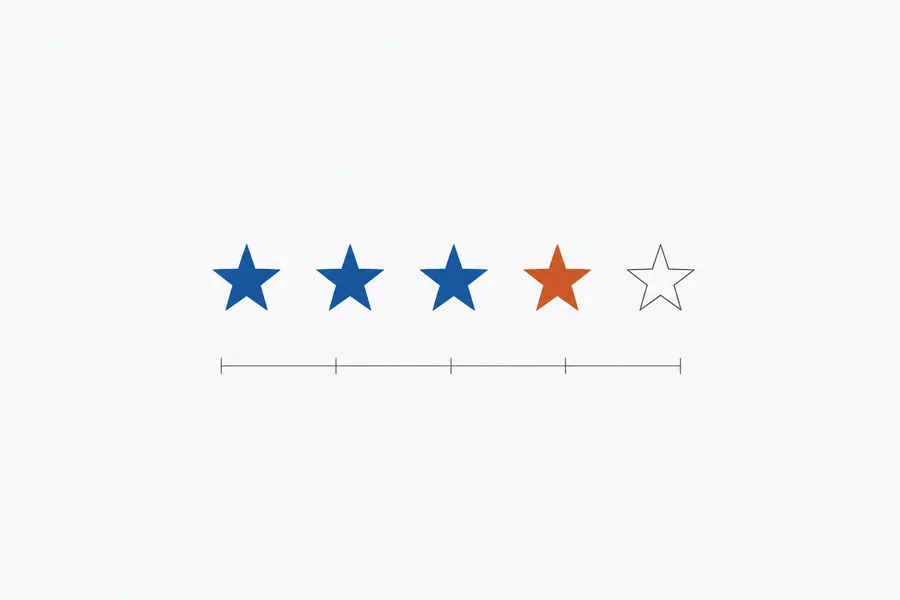
What is review gating?
Review gating is the practice of screening customers for satisfaction before asking for a public review, so only the happy ones are sent to the review platform and the unhappy ones are diverted to a private form. Review platforms prohibit it as manipulation of their content, and the Federal Trade Commission's rule on consumer reviews and testimonials treats suppressing reviews on the basis of their rating or sentiment as an unfair or deceptive practice. This page covers how gating works, what each rule actually reaches, and what you are free to do instead.
What review gating looks like in practice
The usual implementation is a two step message. A customer receives a survey asking how the job went, often as a one to five rating or a thumbs up and thumbs down. Anyone who answers favourably gets the next screen with a button straight to your Google listing. Anyone who answers unfavourably gets a form that emails the owner. Nothing in the flow is hidden, and plenty of software has shipped it as a headline feature.
The intent is usually not cynical. An owner who has been burned by one unfair review wants to avoid another, and the flow feels like customer service: catch the problem privately, fix it, keep the public record accurate. That reading is understandable and it is still the wrong side of the line, for reasons that are published rather than a matter of opinion.
Platform policy prohibits it
Review platforms treat selective solicitation as manipulation of their content, because it is. Google's user generated content policies for Maps set out the categories of prohibited content, with fake and misleading content and reviews at the top of the list, and the same policy set covers soliciting or discouraging reviews on the basis of expected sentiment.
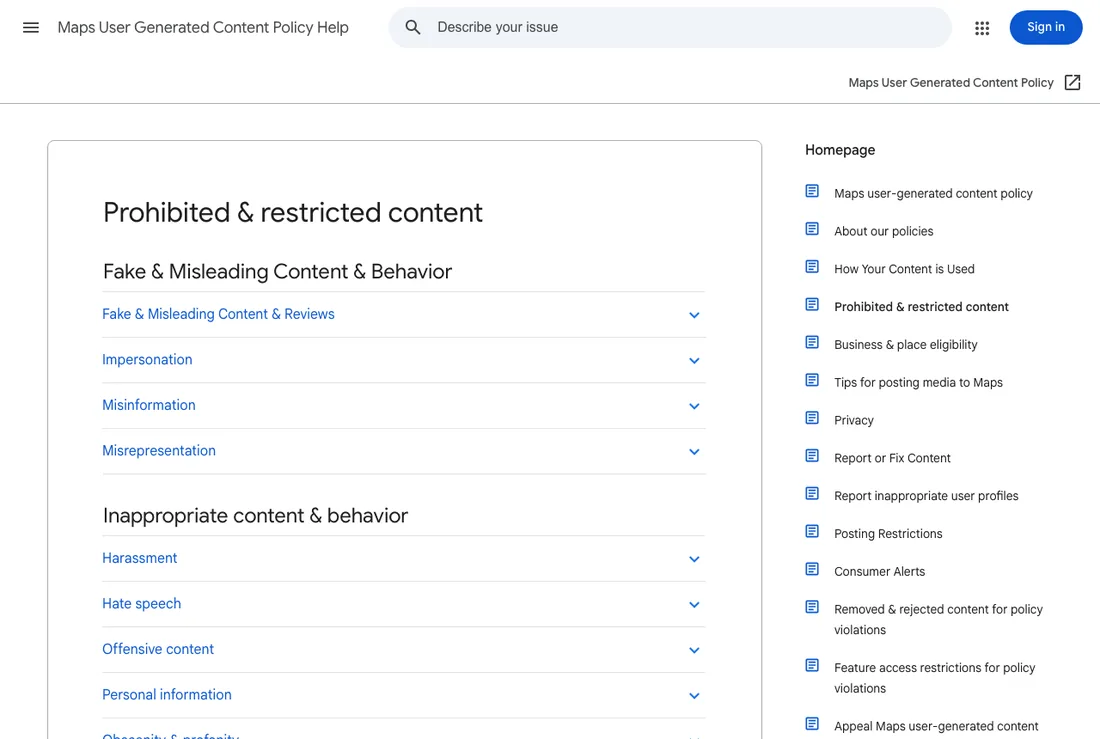
Google's prohibited and restricted content policy for Maps. Note the sidebar entries for removed and rejected content and for feature access restrictions, which are the two enforcement outcomes a gated listing risks. Screenshot taken 19 August 2026.
Enforcement is not limited to deleting the offending reviews. A profile can lose the ability to receive reviews, and reviews gathered through a gated flow can be removed in bulk long after they were collected, which takes down the rating you spent a year building. Because gating produces a distinctive statistical signature, a distribution of near perfect ratings arriving in tight clusters from a single request tool, it is exactly the kind of pattern automated detection is built for. Detecting manipulated review distributions is a long running research field in its own right, with the published work indexed in the ACL Anthology of natural language processing research.
The federal rule: review suppression
Since the Federal Trade Commission's rule on consumer reviews and testimonials took effect, suppression of reviews has its own section in the Code of Federal Regulations.
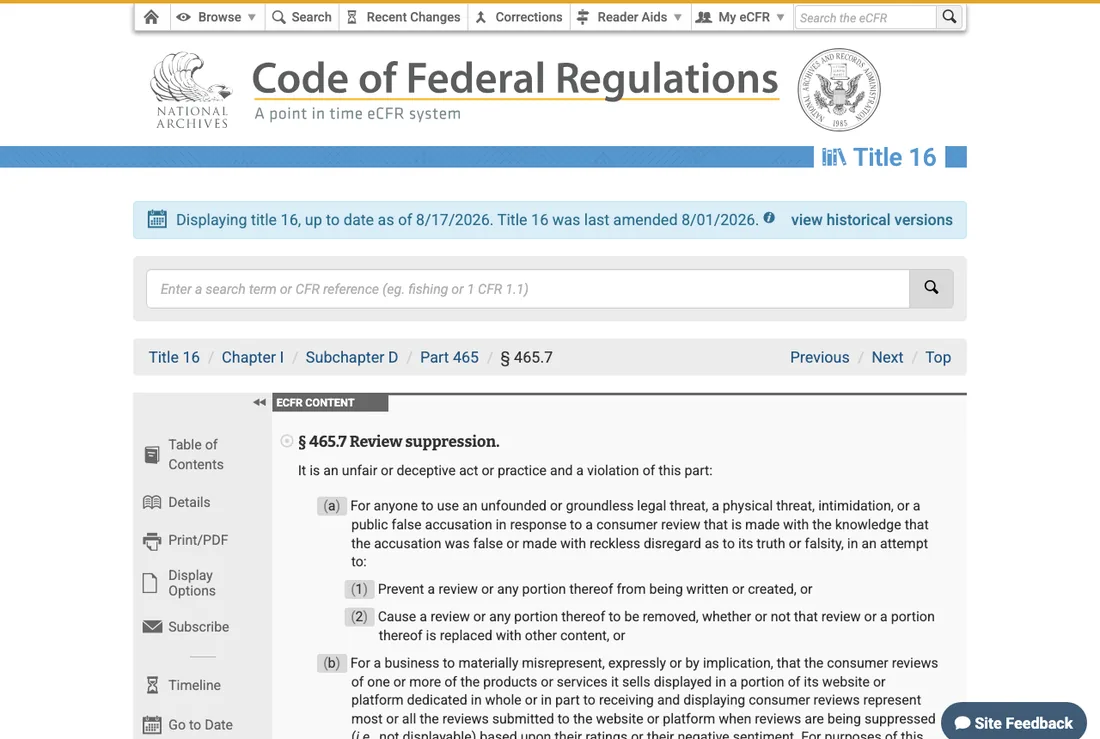
Section 465.7 of the FTC rule, on the eCFR. Subsection (b) makes it an unfair or deceptive practice for a business to misrepresent that the reviews it displays represent most or all reviews submitted, when reviews are in fact being suppressed based on their rating or their negative sentiment. Screenshot taken 19 August 2026.
Read the provision carefully, because the distinction it draws is the one most articles on this topic blur.
| Practice | What the rule reaches | Where the exposure sits |
|---|---|---|
| Collecting reviews on your own site and publishing only the positive ones | Directly, as review suppression under Section 465.7(b) | Federal, if the display implies the reviews are representative |
| Threatening a reviewer to force a review down | Directly, under Section 465.7(a), where the threat is unfounded | Federal |
| Routing only happy customers to a third party platform | Not the display provision, since you are not the one displaying | Platform policy, and enforcement by that platform |
| Asking every customer for a review, whatever they think | Nothing. This is the compliant practice | None |
So the honest summary is two sentences. Gating the reviews you host and display is squarely within the federal rule when the result misrepresents what customers actually said. Gating who you send to Google or another platform is primarily a platform policy violation, and platform enforcement is faster and more common than a federal enforcement action against a small business.
Why gating costs more than it protects
Set the rules aside for a moment; the practice underperforms on its own terms.
- You lose the signal. Diverted complaints are the cheapest market research available. A business that hears about a recurring problem from ten private forms and never publicly fixes it has bought silence rather than improvement.
- Uniform ratings give a reader nothing to calibrate. People read the negative reviews and the replies to them precisely because that is where a business shows how it handles problems. A wall of fives with no texture removes your best opportunity to demonstrate that.
- The unhappy customer does not disappear. Diverting someone who wanted to be heard often relocates the complaint somewhere you control even less, including formal channels. It is worth knowing in advance how Better Business Bureau complaints work, because that page is public, it ranks, and the response window is short.
- The rating is retractable. A rating built through a prohibited flow is not durable. Removal in bulk resets you to a low count with a fresh timestamp, which is the worst position on any listing.
What is allowed instead
Everything that treats all customers the same is allowed, and most of the lift is here.
- Ask everyone. Every completed job, no filter, no pre screen. Volume from an unfiltered ask is what makes a rating credible.
- Ask at the right moment. Immediately after the work is finished and while the outcome is fresh, in whichever channel the customer already uses with you.
- Make it one tap. A direct link to the review form. Friction, not filtering, is what suppresses reviews for most businesses.
- Offer a private channel to everyone, in addition. A support line or feedback form shown to all customers alongside the review link is service. Shown only to the unhappy, in place of the review link, it is gating.
- Reply in public, especially to the critical ones. The reply is read by the next customer, and it is the part you fully control.
- Report reviews that break a published policy. Fake, off topic, conflicted or harassing content has a removal route, which is a different thing from filtering who gets to speak.
Nobody offering to build you a five star rating by selecting who is asked is offering you an asset you get to keep. If you are not sure whether the flow your software runs crosses the line, that is a question a reputation audit can answer by looking at the flow itself.
Questions about what is review gating?
What is review gating?
Screening customers for satisfaction first, then asking only the satisfied ones to leave a public review while routing the dissatisfied to a private feedback form. The filter is the gate.
Is review gating illegal?
Suppressing reviews on the basis of their rating or negative sentiment, and then presenting the surviving reviews as representative, is an unfair or deceptive practice under Section 465.7 of the FTC rule on consumer reviews and testimonials. Selectively routing customers to a third party platform is primarily a platform policy violation, and platforms enforce it far more often.
Does Google prohibit review gating?
Yes. Google's user generated content policies treat soliciting reviews selectively on the basis of expected sentiment as prohibited content, and enforcement ranges from removing the affected reviews to restricting a profile's access to review features.
Can I ask only my happy customers for a review?
No, that is the definition of gating. You can ask every customer, ask promptly, and make the link easy to use. The unfiltered ask is what makes the resulting rating durable.
Can I still offer a private feedback form?
Yes, as long as everyone sees it. A support channel offered alongside the review link is service. A support channel offered instead of the review link, to people predicted to be unhappy, is the gate.