What tools do reputation managers use?
Practitioners use tools for six jobs: seeing what is published, being alerted when it changes, capturing dated proof of it, filing removal and correction requests, running a review programme, and measuring whether anything moved. Every one of those jobs has a free option that works and a paid option that adds coverage, history or shared access. The free tier is more capable than the paid tier's marketing suggests, and it runs out at scale rather than at capability. No tool in any price band decides anything, and the decisions are where outcomes actually come from.
The reputation management tools that do real work
A toolkit is organised by job, not by brand. There are six jobs in this work that a tool genuinely helps with: seeing what is there, being told when something changes, capturing proof of it, filing requests, running reviews, and measuring whether anything moved.
| The job | Free option | Paid option | What no tool will do |
|---|---|---|---|
| See what is published | A logged out browser and patient searching | SERP tracking with position history | Tell you what matters to your buyers |
| Be told when it changes | Alert services and platform notifications | Mention monitoring with wider source coverage | Decide what deserves a response |
| Capture proof | Dated screenshots and public web archives | Timestamped capture with retention | Make a bad record disappear |
| File a request | The platform's own public report forms | A managed filing service | Compel a platform to agree |
| Run reviews | The business dashboard the platform gives you | A review platform with request automation | Manufacture customers |
| Measure | Search Console for sites you own, plus a spreadsheet | Reporting suites with scheduled exports | Give you a single meaningful score |
The pattern down the last column is the point. Tools reduce the labour of finding and filing. They do not change any decision, and the decisions are where the outcomes live.
Free tools, and how far they actually go
The free tier of this category is more capable than the people selling the paid tier tend to mention. Search engines publish their own removal request tools. Every review platform and social network publishes a report form. Data brokers are required to offer opt outs. Alerting on your own name costs nothing.
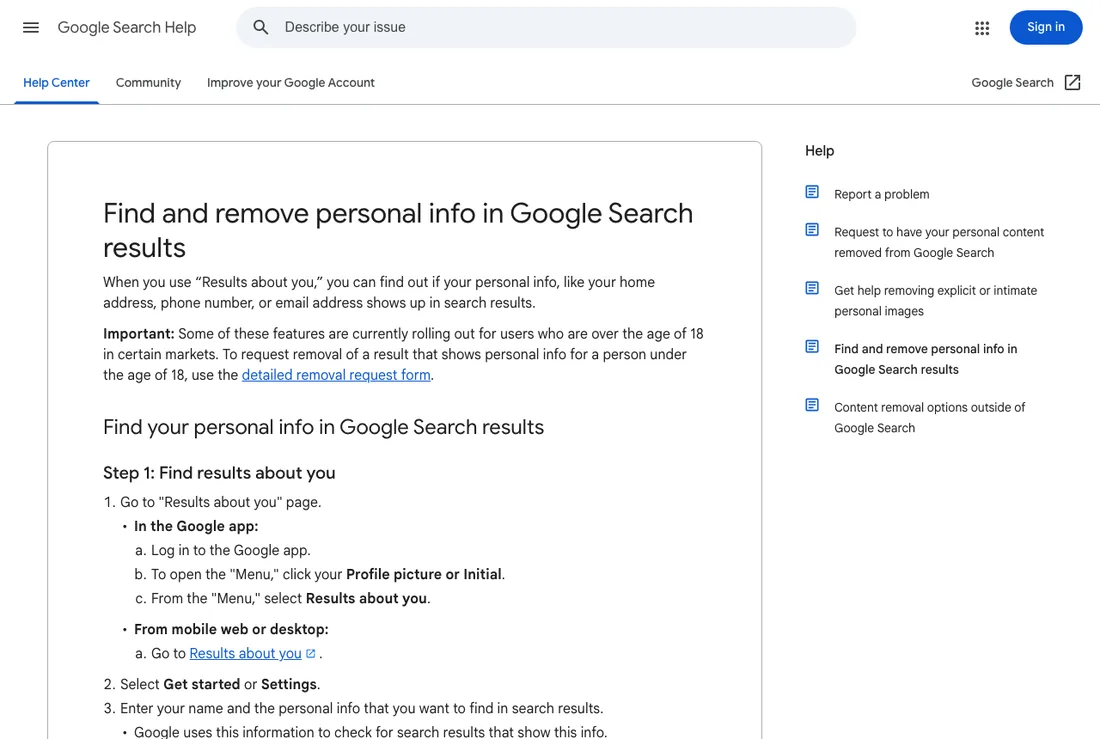
Google's own help page for Results about you. The tool that monitors search for your personal contact details and lets you request removal is published by the platform, free, and requires no intermediary. Screenshot taken 19 August 2026.
Where free stops is at scale, at argument, and at production. Filing three requests yourself is an afternoon. Filing sixty, tracking them, appealing refusals and doing it again next quarter is a job. Our page on doing this yourself walks the free routes in order and marks the point where each one runs out.
Monitoring and alerting tools
An alerting tool watches for new occurrences of a string and tells you about them. Free alert services cover indexed web pages and news reasonably well and social platforms poorly. Paid monitoring tools widen the source list, add historical search, and let several people share one queue.
Set them up for the phrasings people actually use rather than only your exact legal name: common misspellings, your name with your city, your brand with words like reviews, complaints or lawsuit. Then send the alerts somewhere a person will read them. Our page on reputation monitoring covers the setup in more detail.
Evidence capture tools, and why dating matters
This is the least discussed category and the one people regret skipping. Online content changes and disappears. A review gets edited, a post is deleted, a page is rewritten. If your only record is a memory, you have nothing to show a platform, a lawyer, or an insurer.
Capture is simple: a full page screenshot, a printed PDF of the page, the URL, and the date and time. Public web archives let you create a citable dated copy of a live page, which is stronger than a screenshot because it is held by a third party. Keep it all in one folder with a plain text log. This costs nothing and is the difference between a complaint and an evidenced complaint.
Review tools, and the compliance line inside them
The platform's own business dashboard is free and does most of what a small operator needs: it shows your reviews, lets you reply, and gives you a link to send. Paid review tools add automation, multi platform inboxes and reporting.
The line to stay on the right side of is who gets asked. Requests must go to customers evenly rather than only to the ones expected to be positive, and incentives cannot be conditioned on the sentiment of what someone writes. The FTC set this out when it published the final rule banning fake reviews and testimonials, which also reaches insider reviews and the use of groundless legal threats to remove a negative one. A tool that offers to screen customers before asking is a compliance problem wearing a feature name, and our page on review gating explains why.
Paid tools: what the money buys
Paid tools buy coverage, aggregation, history and shared access. That is worth real money when you have volume, several locations, or more than one person who needs the same view. It is worth very little when the whole situation is one result about one person.
What paid tools do not buy is judgement or labour. The occupation that does this work is a communications role, and the Bureau of Labor Statistics profile for public relations specialists describes it in those terms: writing, relationship building, and responding on behalf of an organisation. No subscription performs that. It only makes the inputs easier to see.
Choosing reputation management tools for your situation
Start from the job, not the product. If nothing you own ranks for your name, a monitoring subscription is premature; publishing is the priority. If you have volume of reviews, review tooling pays for itself first. If you are heading toward a dispute, evidence capture matters more than anything else on this page.
Then check the one thing tools rarely advertise: whether you can get your data out, and whether the accounts and profiles connected to the tool remain yours if you stop paying. Which tools your situation actually calls for is one of the things a reputation audit settles, and it is a cheaper way to find out than a year of subscriptions.
Questions about reputation management tools
What tools do reputation managers use?
Search run logged out for a baseline, alerting on name variants, evidence capture through dated screenshots and public web archives, the platforms' own report and removal forms, a review dashboard, and position tracking for the results that matter. Paid suites bundle several of those together.
Are there free reputation management tools?
Yes, and they cover most of the work. Search engines publish their own removal request tools, every review platform and social network publishes a report form, data brokers are required to offer opt outs, and alerting on your own name costs nothing. Free runs out at scale, not at capability.
What is the most underrated tool?
Evidence capture. Content gets edited and deleted, and a memory is not a record. A dated full page screenshot, a PDF, the URL, and a copy held in a public web archive turn a complaint into an evidenced complaint, and it costs nothing.
Do I need a paid monitoring subscription?
Only if you have volume, multiple locations, or several people who need the same view. For one name or one location, free alerting plus the platform's own dashboard usually covers it. Spend the money on the work before you spend it on watching.
Can a tool get content removed?
No. Tools make filing faster and tracking easier. Removal is a decision made by a platform, a publisher or a court, and nothing in a dashboard compels it.