What is Section 230?
Section 230 is the twenty-six word rule that decides who is responsible for what appears on the internet. It is the reason a review site cannot usually be ordered to take a review down, and the reason most reputation work runs through platform policy rather than a courtroom. This page explains what the statute says, why it was written, what it does not cover, and what all of that leaves you if something about you is online.
What Section 230 actually says
The operative sentence is twenty-six words long and sits at 47 U.S.C. Section 230(c)(1): no provider or user of an interactive computer service shall be treated as the publisher or speaker of any information provided by another information content provider. Stripped of the statutory vocabulary, it means a website is not legally the author of what its users post there.
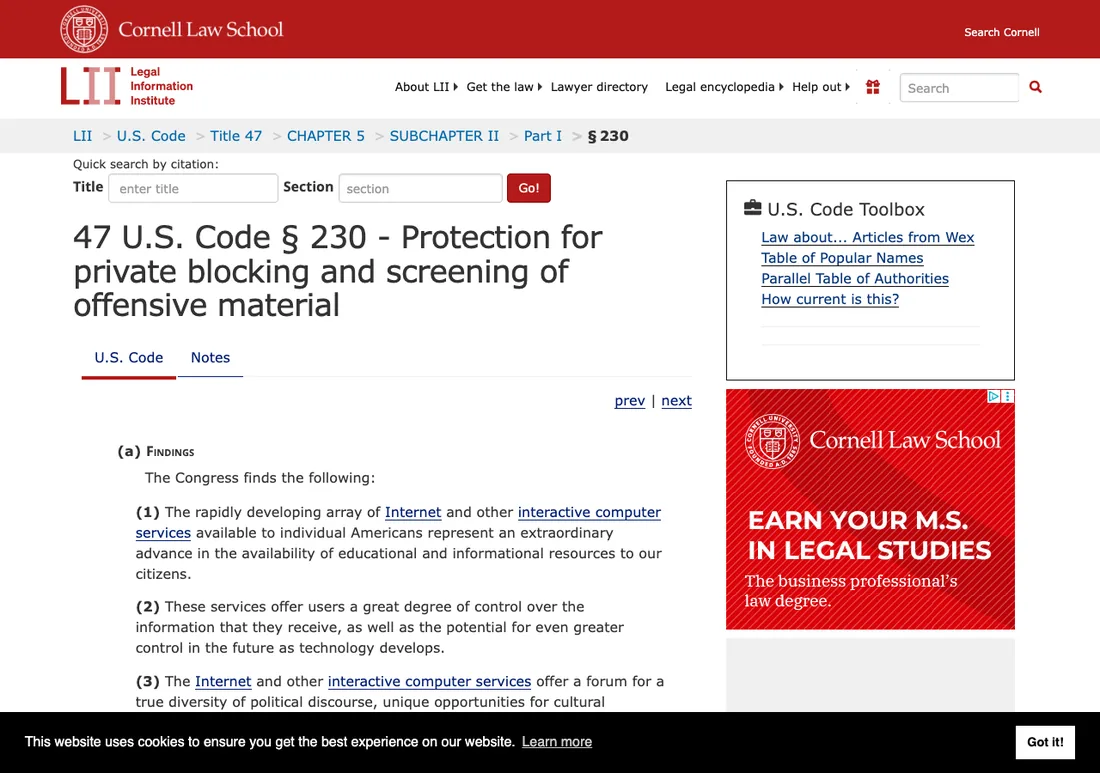
The statute itself, at Cornell's Legal Information Institute. Subsection (c)(1) is the twenty-six words the rest of this page is about. Screenshot taken 19 August 2026.
That is the whole mechanism. Google is not the author of a Google review. Yelp is not the author of a Yelp review. Reddit is not the author of a Reddit thread. The person who typed it is the author, and the law directs liability at them.
Section 230(c)(2) does a second, less famous job: it protects a platform from liability for removing content it considers objectionable. Both halves matter. The first means a platform cannot easily be forced to leave content up or take it down; the second means it can moderate freely without inheriting responsibility for everything it chose not to remove.
Why the law was written this way
Section 230 arrived in 1996 as part of the Communications Decency Act, and it was a direct response to a genuine problem. Two early cases had produced an incoherent result: a service that made no attempt to moderate was treated as a mere distributor and escaped liability, while a service that did moderate was treated as a publisher and became liable for everything it missed. The practical lesson for any platform was to moderate nothing.
Congress removed that penalty. A platform can set and enforce rules without becoming the author of every post it did not catch. Whatever one thinks of the result, the rule is doing what it was designed to do. The Electronic Frontier Foundation keeps a working history of the provision and the cases around it if you want the fuller account.
What this means when you want something removed
This is where the abstraction becomes concrete, and it is usually not the answer people want.
- A court will rarely order a platform to remove a user's post. The platform is not the publisher, so a defamation claim against the platform generally fails at the threshold. The claim belongs against the author.
- A judgment against the author does not automatically clear the content. Some platforms honour a court order finding a specific statement defamatory; that is policy, not obligation, and the honouring is inconsistent.
- Platform policy is the faster door, and often the only one. Every major platform publishes rules about what it will remove. Content that violates those published rules comes down through a complaint, without a lawyer, usually in days rather than months. Content that is merely unflattering does not.
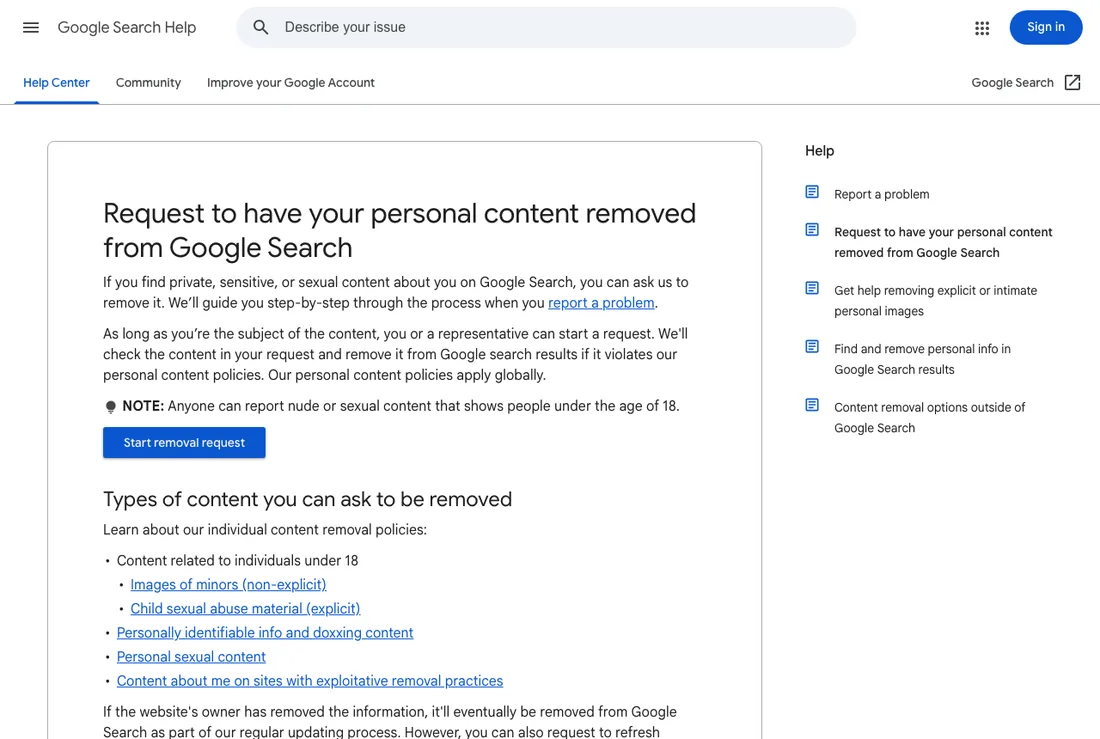
Google's own removal troubleshooter. It exists independently of Section 230 because it runs on Google's policies, not on liability. This is the door most people should try first. Screenshot taken 19 August 2026.
- Anonymity is a practical obstacle, not a legal shield. An anonymous author can sometimes be identified through a subpoena during litigation, but that is a real lawsuit with real cost and it makes the dispute public.
The realistic sequence for most people is therefore: check the content against the platform's published policy first, use the legal route where a specific law reaches the content directly, and treat suppression as the answer for lawful material that is simply unwelcome.
What Section 230 does not cover
The immunity is broad but it is not universal, and the exceptions are where legal removal actually lives.
- Federal criminal law is carved out entirely. Section 230 is not a defence to a federal crime.
- Intellectual property claims are excluded. This is why a copyright notice under the DMCA is a genuinely different route with different mechanics: it reaches the platform directly. The Copyright Office sets out how the Section 512 notice and counter-notice process works.
- Content the platform itself created or materially developed falls outside the protection. A platform that writes or substantially shapes the content is the author of it.
- Sex-trafficking claims were carved out by FOSTA-SESTA in 2018.
- The author is never protected. Section 230 shields the intermediary. The person who wrote a false statement of fact remains exposed to an ordinary defamation claim.
Section 230 is under active pressure
Both major American political parties have proposed narrowing or repealing it, for opposite reasons, and the Supreme Court has taken cases circling its edges without disturbing the core. Several state legislatures have passed laws that test its boundaries.
None of that has changed the operative rule as of this writing, and a page that told you otherwise would be selling urgency. But it does mean that any advice keyed to Section 230 is advice with a shelf life, and if you are reading this well after publication it is worth checking whether the ground has moved.
What to do with this
If something about you is online and you want it gone, Section 230 tells you where not to aim. Do not spend months trying to compel a platform to act on a theory it is immune from. Aim instead at whichever of these actually reaches your content:
- The platform's own published policy, if the content violates it. Free, fast, and the most common successful route.
- The author, if the statement is a false statement of fact and you are prepared for what litigation involves.
- A specific statute that bypasses the immunity, most often copyright, or the privacy rules that govern certain categories of personal information.
- Suppression, when the content is lawful, policy-compliant, and simply not going anywhere.
Knowing which of those four you are in is most of the work, and it is the first thing a reputation audit establishes.
Questions about section 230
Does Section 230 protect Google reviews?
It protects Google from being treated as the author of a review a user wrote. It does not protect the reviewer, and it does not stop Google removing a review under its own published policies.
Can I sue a website for something a user posted?
Generally no. Section 230 directs the claim at the person who wrote the content rather than the service that hosted it, except in the carved-out categories such as federal crimes and intellectual property.
Does Section 230 apply to AI-generated answers?
That is genuinely unsettled. The immunity is written around information provided by another information content provider, and courts have not resolved how it applies when a model composes the statement itself.
What is the fastest way to get content removed given Section 230?
Check it against the platform's published policy first. Policy violations are removed through a free complaint, usually in days. That route is unaffected by Section 230 because it does not depend on liability at all.