How are AI answers built?
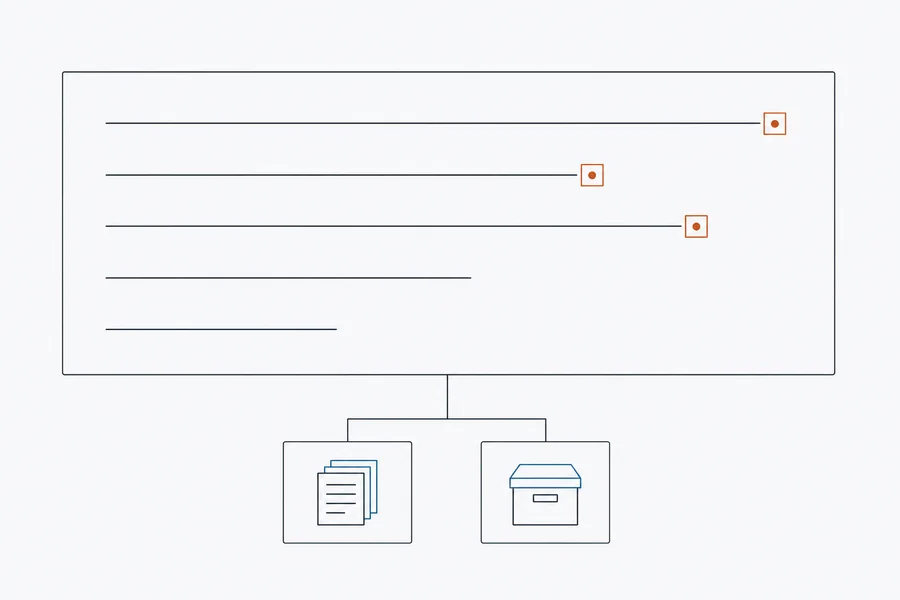
An AI answer is built from two separate things. The first is a model trained on a large body of text gathered up to a cutoff date, which it carries as statistical structure rather than as stored documents. The second, in most consumer assistants, is a live retrieval step that searches the web while the answer is being written and summarises what it finds. The sentence you read is composed fresh each time from whichever of those two the system leaned on. That distinction decides what can be changed about an answer and what cannot, so it is worth understanding before anything else.
Training data, and what it fixes in place
Pretraining is the stage where a model is exposed to a very large collection of text and learns the patterns in it. What it retains is statistical structure, not filed copies. There is no index inside the model, no list of the pages it read, and no record you can request. This is the part of the system that is genuinely fixed between releases.
Two practical consequences follow. A model can produce a fluent, confident sentence about a small business with nothing retrievable behind it, because the sentence was generated rather than looked up. And a claim absorbed during training can keep appearing after the page that carried it has been corrected or deleted, because deleting a page does not reach back into a model that already learned from it.
Web retrieval, and why it is the reachable half
Most assistants people actually use can search the live web mid answer. The system runs one or more queries, reads what comes back, and writes a summary of it, usually with links. OpenAI's documentation on web search in its models sets out the mechanism plainly: the model is handed search results and composes its reply from them.
This half behaves much more like ordinary search, which is good news if you want something to change. It is reading pages that exist right now. Correct the page and the next retrieval reads the corrected version.
Source selection: how a system decides what to read
Retrieval does not read everything. It reads a handful of results, and which handful you land in is close to a search-ranking question with some extra weighting.
| Where the statement came from | How it usually reads | What actually reaches it |
|---|---|---|
| Pretraining, no live sources | Confident, no links, sometimes out of date | New publishing over time; nothing immediate |
| Live retrieval of a page | Summarised, usually with citations | Correcting, removing, or outranking that page |
| A mix of both | Broadly current with one stale detail | Fixing the retrieved sources, then rechecking |
| A structured profile or listing | Specific facts such as hours or address | Correcting the listing at its own source |
Beyond ranking, three things appear to matter. Agreement helps: a claim repeated consistently across several independent sources is easier for a system to treat as settled. Clarity helps: a passage that answers a question in one self-contained paragraph is easier to lift than the same fact spread across a page. And attribution helps. The research paper that introduced Generative Engine Optimization tested content changes against generative engines and reported measurable gains for pages that added citations, quotations, and sourced statements, rather than for pages that simply added keywords.
That research is early, it tested a limited set of systems, and the field has moved since. Treat it as a direction of travel, not a formula.
Confidence and hallucination sound identical
A model has no built-in way to tell you how sure it is. The prose reads the same whether the underlying claim is well supported or invented, and fluency is not evidence. Cited answers are better but not safe: a citation can be attached to a sentence the source does not actually support, which is why the useful habit is to open the links rather than trust that they were checked.
This is different from predictive features people sometimes lump in with it. Google's autocomplete, for instance, is not generating claims at all. As Google's explanation of how Autocomplete predictions work describes, those predictions are drawn from real searches people run. Same screen, different machine, different fix.
Why old content resurfaces
Four ordinary reasons account for most of it. The claim came from training, so the correction never reached it. A copy of the original still exists somewhere the retrieval layer can find, on a syndication partner, an aggregator, or an archive. The corrected page has not been recrawled yet. Or the corrected page exists but ranks below the old one, so retrieval never reads it.
None of that is mysterious, and none of it requires a special theory about machines holding grudges. It is a chain of ordinary publishing steps, and each link in it can be worked on.
What this means if you want an answer changed
You do not file a request with a model. You change what it reads, then you check again.
- Establish what is actually being said. Ask the assistants directly, several times, in fresh sessions, and record the replies verbatim.
- Trace each wrong statement to a source. Where an answer cites, open the citations. Where it does not, search the claim as written.
- Fix or remove it at the source. A correction on the original page, a platform complaint where a policy is broken, or a legal route where one genuinely applies.
- Publish accurate material the retrieval layer can find. Clear, self-contained, and consistent with every other place your name appears.
- Recheck on a schedule. Retrieval-driven answers usually move first. Training-driven ones move on their own timetable, and nobody can promise when.
Working out which of those two halves a given statement came from is most of the diagnosis, and it is one of the first things a reputation audit tries to establish.
Questions about how ai answers are built
How does AI decide what to say about a business?
It combines what the model absorbed during training with whatever it retrieves from the live web at the moment you ask. The reply is generated from those inputs rather than looked up in a database.
Where does AI get its information?
From two places: a large body of text collected up to a training cutoff, and live search results fetched while the answer is written. Only the second half reflects what is published today.
Why does an AI answer cite a source that does not say what it claims?
Because the citation and the sentence are produced by the same generation step. A link can be attached to a claim the page does not support, so opening the citations is worth the minute it takes.
Can I see which pages a model was trained on?
No. Training data is not exposed as a list, and the model does not retain retrievable copies. You can only see the sources a system cites when it retrieves them live.