
Do employers google you?
Yes. Most hiring involves at least an informal search of a candidate's name, and a large share of employers also order a formal background check from a screening company. Those are two different activities with two different rule sets. The informal search is largely unregulated and reaches whatever is publicly visible, with no notice to you. The formal check produces a consumer report, which carries federal rights: written authorisation, a copy of the report before it is used against you, and a route to dispute what is wrong. Knowing which one is happening tells you what you can change and what you can contest.
Two kinds of screening, and why the difference matters
An employer looking into you is doing one of two things, and often both.
The first is an informal search. A recruiter or hiring manager types your name into Google, reads the first page, opens your LinkedIn profile, and looks at whatever social accounts are public. No one is required to tell you this happened. There is no file, no report, and nothing to correct.
The second is a formal background check ordered from a screening company: criminal record searches, employment and education verification, sometimes driving records or credit history. That report is a consumer report under federal law, and the law attaches a procedure to it.
| Question | Informal name search | Consumer report |
|---|---|---|
| Who performs it | The recruiter or hiring manager | A third-party screening company |
| Your permission | Not required | Written authorisation required |
| Are you told | Usually not | Yes, before and after adverse use |
| Do you see the findings | No | Yes, you can request a copy |
| Can you dispute it | No | Yes, with the agency and the source |
| What it reaches | Anything publicly visible | Defined records, within legal limits |
That distinction is the practical core of this page. The informal search is something you influence by changing what is published. The consumer report is something you contest through a process.
What recruiters actually find
A name search resolves in a predictable order, and it is rarely the order people fear. LinkedIn usually ranks first for a professional name. After that come any profiles you own, an employer's staff page, news mentions, social accounts that are set to public, and further down, people-search aggregators that assemble an address history and a list of relatives from public records.
The image tab is the part candidates forget. It pulls from social profiles, event photographs, and any site that published a picture with your name near it, and it is often where an outdated or mismatched impression comes from.
What a recruiter sees is not the same as what exists. A locked account shows a name and a profile photograph and nothing more. A post inside a private group is generally not indexed. The gap between what is on the internet and what surfaces in a search is where most of the useful work sits, and the page on what shows up when someone googles you covers how to see it the way they do.
The legal limits on screening
Employers are allowed to search. What constrains them is what they do next, and how they source the information.
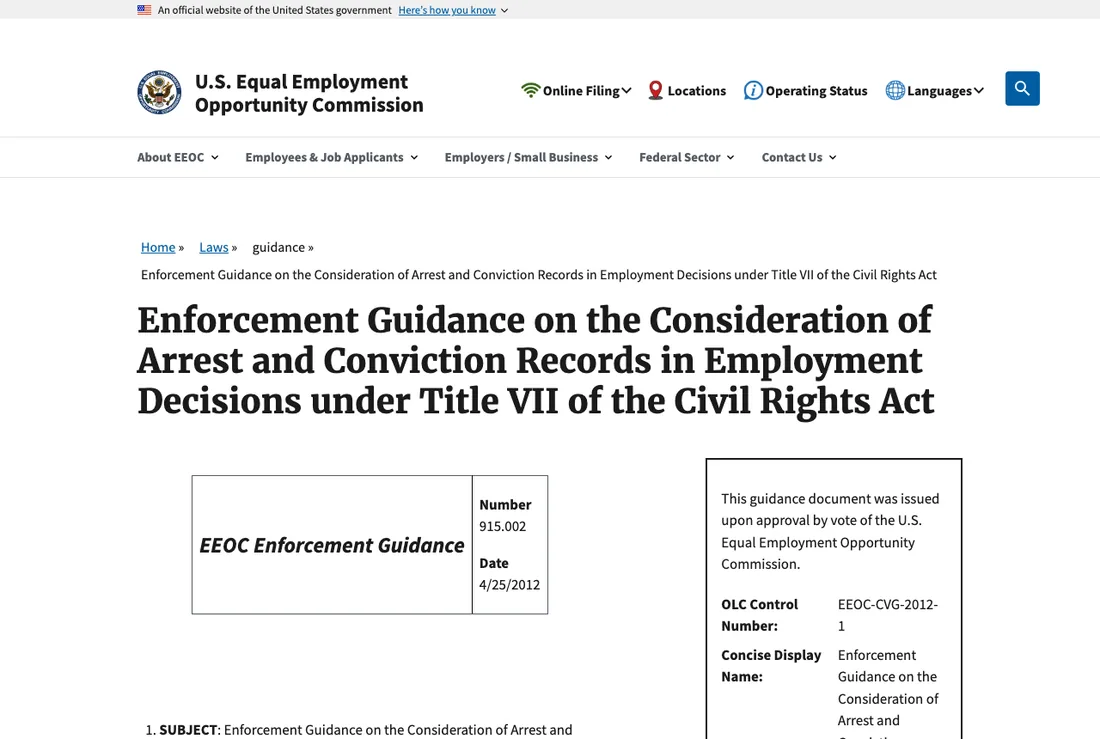
The federal guidance that governs how criminal history may be used in hiring. It distinguishes an arrest, which is not proof that conduct occurred, from a conviction, and it treats blanket exclusions as a discrimination risk rather than a neutral policy. Screenshot taken 19 August 2026.
The federal position on criminal records is set out in EEOC guidance on using arrest and conviction records in hiring. Two points in it matter to a candidate. An arrest record on its own does not establish that criminal conduct occurred. And an across-the-board rule excluding anyone with a record can produce a discriminatory effect even when it was not intended to, which is why employers are pushed toward assessing the nature of the offence, the time elapsed, and its relationship to the job.
State law adds more. Many states restrict when a criminal history question may be asked, many prohibit an employer from demanding your social media password or requiring you to open an account in front of them, and several limit the use of credit history for roles where it is not relevant. These vary enough that the only reliable answer is your own state's.
Social media screening: what they may look at versus what they may act on
This is the distinction that confuses most people, and it is worth stating plainly. A public social profile can reveal age, religion, national origin, a pregnancy, a disability, or family status. Looking at a public page is not generally unlawful. Making a hiring decision because of a protected characteristic is. The difficulty is evidential rather than legal: once an employer has seen something, proving it was not a factor becomes hard.
That is precisely why many organisations route screening through a third party and instruct the hiring panel not to run their own searches. It is a liability decision, not a courtesy. It also means the formal report, with its rules and its paper trail, is often the more consequential of the two channels even though the informal search is the one candidates worry about.
Adverse action, and the notices attached to it
If a screening report is going to cost you the job, the process is defined. FTC guidance for employers using consumer reports sets out the sequence: written authorisation before the report is pulled, a copy of the report plus a summary of rights before adverse action is taken, and a formal adverse action notice afterward identifying the agency that supplied it.
The window between those two notices is the only leverage you get, and it is short. Use it to read the report rather than to argue with the employer. Errors in background reports are ordinary rather than exotic: a record belonging to someone with your name, a charge shown without its dismissal, an employment date wrong by a year, a debt that was settled. The CFPB on credit reports and background screening explains how to obtain your file and how the dispute process runs, including the agency's obligation to reinvestigate.
What to do before an employer googles you
- Search yourself the way they will, signed out, on your full name and on your name plus your city and employer, and record what appears.
- Fix what you control first. Privacy settings, an outdated profile photograph, an abandoned account under your name.
- Order your own background report before applying if you have any reason to expect a record, so a surprise is not shared in real time with an employer.
- Correct errors at the source, not just with the screening company, because the next report pulls from the same place.
- Leave truthful records alone and prepare how you will discuss them. A dismissed charge that is accurately reported is not a removal candidate, and treating it as one wastes the time you have.
Most candidates find their search returns nothing alarming and one or two things that are simply out of date. If yours returns something you cannot place, working out which category it falls into is the first thing a reputation audit establishes.
Questions about do employers google you?
Do employers google you?
Most do at some point in the process, and many also order a formal background report. Published survey figures on how many vary widely and this reference does not quote one it cannot source, so plan on it happening.
Is it legal for employers to search social media?
Generally yes, if the profile is public. What is restricted is acting on a protected characteristic they learned there, and in many states demanding your password or requiring you to open an account for them.
Can an employer reject me because of something they found on Google?
They can act on lawful, job-relevant information found in a public search without telling you. If the information came from a third-party screening report instead, they must give you notice and a copy before the decision is final.
How do I find out what a background check will say about me?
Order your own file from the major screening agencies and your credit report before you apply. Correcting an error at the source takes weeks, which is longer than most hiring windows allow.