
Can a news article be removed from Google?
A news article leaves Google's results when the publisher takes it down, when a specific law or court order reaches it, or when you are in a jurisdiction that grants a delisting right. Google does not remove lawful journalism from Search because its subject asks. That is the starting point, and everything useful follows from accepting it. The routes that do exist run through the newsroom, through a narrow set of legal claims, or through suppression, which changes what ranks rather than what exists. This page covers the unpublishing request, the correction, delisting, and clean slate policies.
Why you cannot remove a news article by asking Google
Google indexes what publishers publish. It is not the publisher of the article and it does not have an editorial view about whether the coverage was proportionate.
Its removal policies cover specific categories: certain personal information, content that a court has ordered removed, copyright claims, and a handful of others. Lawful reporting about a real event is in none of them. A request to Google to remove an article because it is old, or because the outcome was different from what the article described, is closed without action, and the time spent on it is the most common wasted month in this whole subject.
The unpublishing request
The publisher is the only party who can make the page stop existing, so that is where a serious request goes.
Most established newsrooms have a written policy on this, often in their ethics or corrections page, and most of them start from a presumption against unpublishing. The reasoning is not indifference. A news archive that can be edited on request is not an archive, and the profession treats the integrity of the record as a genuine obligation.
What that means in practice is that the request most likely to succeed is not the one that argues hardest. It is the one that gives the editor a factual reason to act:
- Address it to the right person, usually a named editor or the standards desk, not a general contact form.
- Identify the article precisely. Headline, date, URL.
- State the factual problem, with documentation. A dismissal, a certificate of disposition, a corrected filing, a court order. Attach it.
- Ask for the specific remedy you want. Removal is one option among several and the least likely to be granted. An update, a name removal, or a noindex are all easier for an editor to say yes to.
- Accept a partial outcome. An article updated with the eventual outcome, or with your name removed, often solves the actual problem.
An editorial correction is more likely than a takedown
This is the underused route. If the article contains a factual error, newsrooms correct errors. That is the one thing every corrections policy commits to.
A correction changes the text, and a follow up piece reporting the eventual outcome changes what a reader learns from the coverage as a whole. Neither removes the URL. Both change what the URL says about you, which for most people is closer to the real goal than deletion was.
There is a second order effect worth knowing. Editors add updates near the top of a piece and often update the publication date. That can renew the article's prominence for a while. It is usually worth it, and it is worth expecting rather than being surprised by.
Clean slate policies
Some newsrooms have gone further and built a formal process. The Boston Globe runs a programme called Fresh Start that accepts requests to update, anonymise, or in some cases remove older coverage of minor matters, and a handful of other regional outlets have set up comparable initiatives.
These programmes are typically aimed at older stories about lower level matters where the subject was not a public figure, and they are decided by editors against published criteria. Where one exists at the publication that covered you, it is by a wide margin the best route available, and it costs nothing but a well written request.
Right to be forgotten delisting
In the EU and UK there is a route with no American equivalent. A person can ask a search engine to delist results returned for searches of their name where the content is inadequate, irrelevant, no longer relevant, or excessive, and the search engine must weigh that against the public interest in the information remaining findable.
Three things about it. It delists the result, it does not touch the article, which stays live at the publisher. It applies to the name query, not to every query. And it is decided by the search engine first, with a data protection authority as the appeal route.
There is no United States equivalent, and proposals for one run into constitutional protection for truthful publication of lawful matters. Any service offering a right to be forgotten filing for an American resident is selling something that does not exist here.
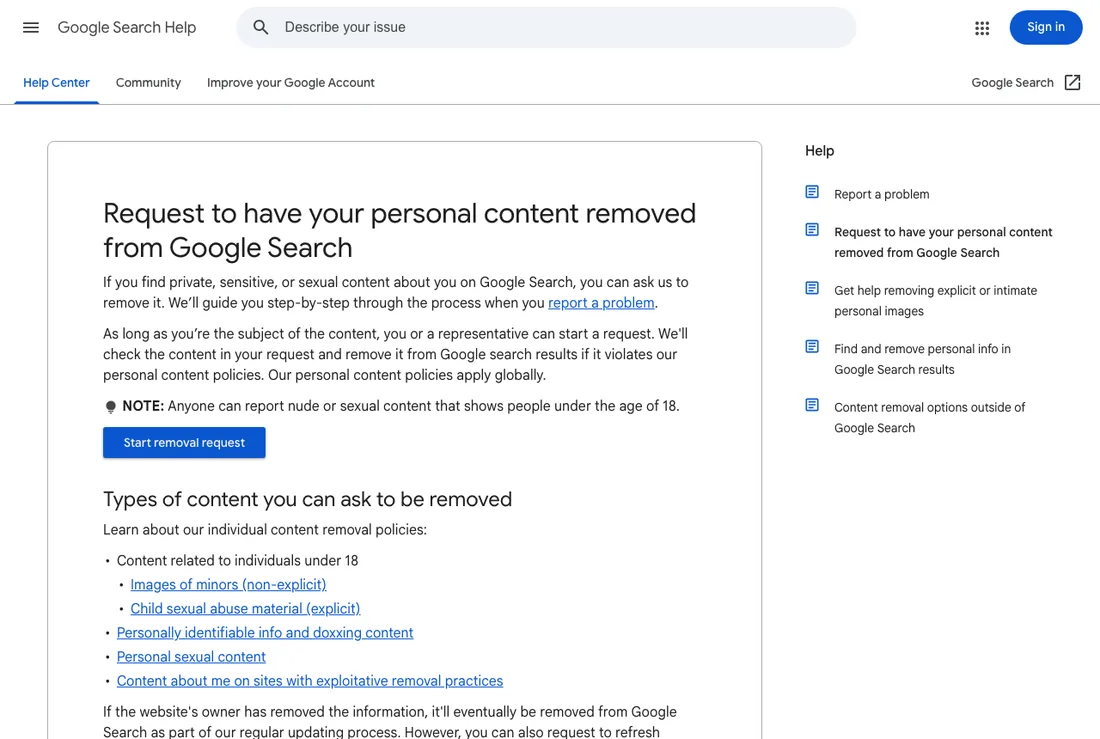
Google's removal troubleshooter routes a request by content type. Follow the path for content on a site you do not own and it ends, honestly, at contacting the site owner. That is the answer this page has been describing. Screenshot taken 19 August 2026.
The legal route, and its real shape
If the article states something false as a matter of fact, the claim is against the publisher, not against Google, and it is a civil lawsuit. How civil cases work in the federal courts sets out the shape of that process, and the shape is the point: pleadings, discovery, cost, and a public docket that is itself indexable. A defamation suit over an article frequently produces more coverage than the article did. That is a strategic fact, not a reason not to sue, and it belongs in the decision with counsel. Nothing here is legal advice.
The suppression alternative
When the article stays, the remaining question is what a search for your name returns. Suppression means giving Google enough better options that the article stops holding a top position: substantial pages about you on sites with their own authority, an unambiguous entity record, professional profiles that are complete and maintained, and genuine new coverage where it is available.
It is slower than a takedown and it is honest about what it does. The article still exists. Anyone who searches the specific story still finds it. What changes is the default picture a name search produces, which is what most people are actually worried about.
Part of that work is the entity layer. Claiming a Google knowledge panel is the verification route where a panel exists, and a correct, well sourced entity record gives Google something authoritative to anchor the name query to.
One disambiguation for business owners: if what surfaces alongside the coverage is a review rather than an article, that is a different track with a different form. Google's process for reporting an inappropriate review handles reviews under the review policies, and nothing in it applies to journalism.
Working out which of these four routes your specific article is in, before the first email, is the first thing a reputation audit does.
What this leaves you
A hierarchy. Correction and update first, because newsrooms say yes to those. A clean slate programme where the publication runs one. A legal claim only where a statement is provably false and counsel thinks the trade is worth it. Suppression for everything else, which is most of it. Nobody can remove lawful reporting on request, and the honest version of this answer is more useful than the version that implies otherwise.
Questions about how to remove a news article from google
Can a news article be removed from Google?
Not by asking Google. Google indexes what publishers publish and its removal policies do not cover lawful reporting. The article leaves results when the publisher takes it down, when a court order or specific law reaches it, or through a delisting right where one exists.
What is an unpublishing request?
A request asking a newsroom to remove a published article entirely. Most publications have a written policy and start from a presumption against it, because an archive that can be edited on request stops functioning as a record.
Is a correction easier to get than a removal?
Usually, yes. Every corrections policy commits to fixing factual errors, so a documented error has a route that a removal request does not. An update reporting the eventual outcome is often closer to the real goal than deletion.
Does the right to be forgotten apply in the United States?
No. It is an EU and UK route that delists results for a name query while leaving the article live at the publisher. Proposals for an American equivalent run into constitutional protection for truthful publication of lawful matters.
Should I sue a publisher over an article?
That is a decision for counsel. A defamation claim requires a false statement of fact rather than an unflattering true one, and litigation is public and produces its own indexable record. Nothing on this page is legal advice.